

Luna Annarita Relics
WWII Poem by Resistance Fighter Belgium
WWII Poem by Resistance Fighter Belgium
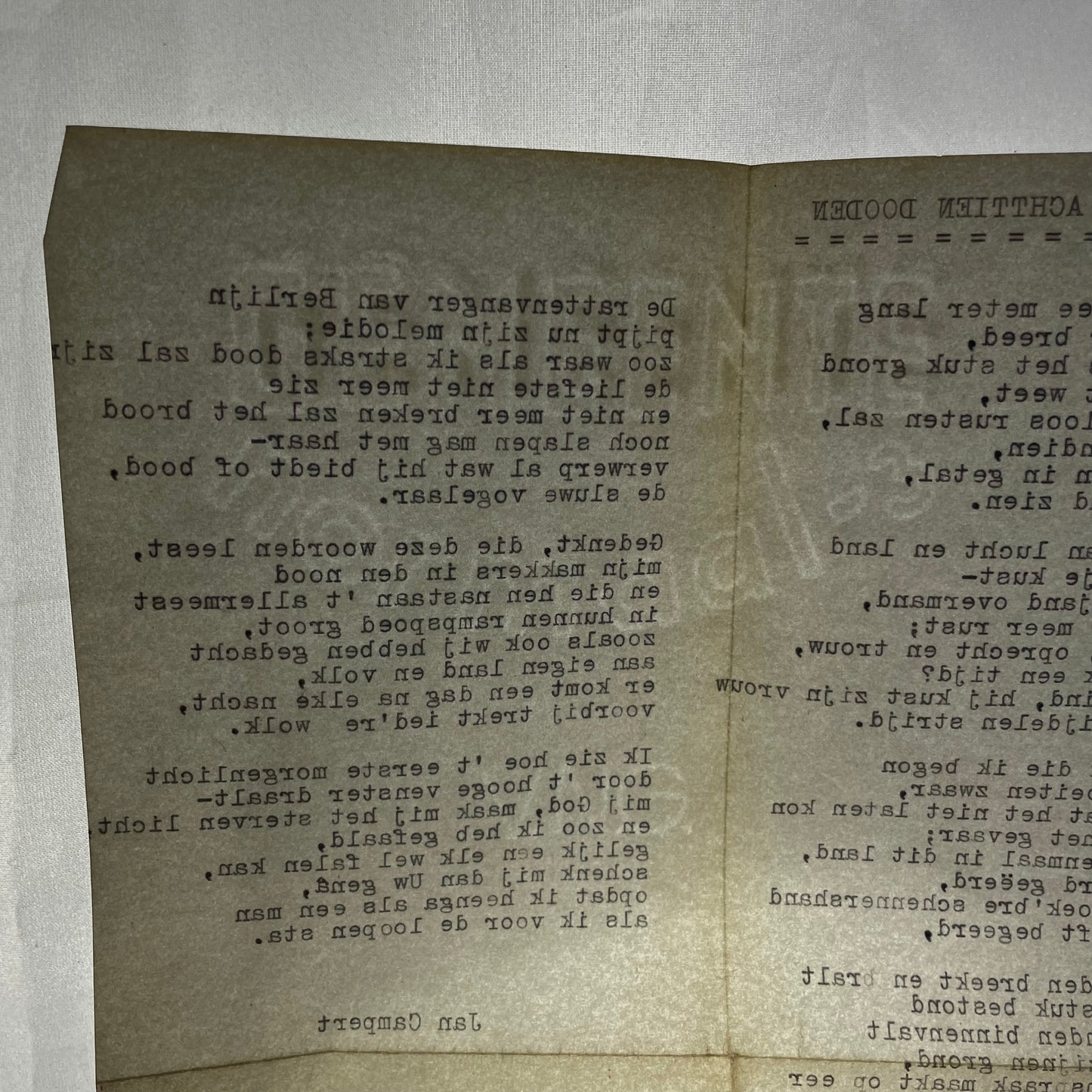
It's a soldier's letter containing "Het lied der achttien dooden" ("The Song of the Eighteen Deaths"), a poem by Jan Campert (1902-1943), a Dutch journalist, poet, writer, and resistance fighter.
Campert was imprisoned in Camp Haaren and Camp Amersfoort (NL). Ultimately, via Buchenwald concentration camp, he ended up in the German concentration camp Neuengamme in November 1942. In December, he was hospitalized twice with lung complaints. On January 6, 1943, he reported chest pain. According to the official statement in his medical file, he died of pleurisy on January 12 of that year at the age of 40.
He wrote the poem after the execution of eighteen resistance fighters on March 13, 1941 at the Waalsdorpervlakte, the Netherlands. It was first published in the illegal newspaper Het Parool on February 10, 1943.
The municipality of Mol, Belgium was occupied by the German army from May 16, 1940 until its liberation on September 24, 1944.
The paper has an invisible branding unless being held against light, that states "Municipality of Mol maat-3 VNG." The VNG is a private association, the "maat-3" could refer to a specific document size or an internal coding within the municipality.
Campert's poem must have been a little relief to this captured resistance fighter in Belgium for him to rewrite it, maybe in his last days. There is also a possibility the resistance rewrote the poem several times to hand out to the public in the Netherlands and Belgium to start an uproar.
- Origin: Belgium (1943-1944)
- Era: WWII
- Condition: Perfect condition
English translation:
A cell is only two meters long
and barely two meters wide,
even smaller is the plot of land,
which I don't know yet,
but where I will rest nameless,
my comrades too,
we were eighteen in number,
none will see the evening.
Oh, loveliness of light and land,
of Holland's free coast,
once overrun by the enemy,
I had no more rest for an hour.
What can a man, sincere and faithful,
do at such a time?
He kisses his child, he kisses his wife,
and fights the vain battle.
I knew the task I was undertaking,
a task of great difficulty,
but the heart that could not resist
never shies away from danger;
it knows how once in this country
freedom was honored,
before a cursed, violating hand
desired it otherwise.
Before that one breaks oaths and brags
that sickening piece existed
and invades Holland's lands
and plunders its soil;
before that one lays claim to honor
and such Germanic convenience
forces our people under his control
and plunders like a thief.
The Pied Piper of Berlin
now pipes his melody, -
as sure as I shall soon be dead,
I will no longer see my dearest
and will no longer break bread
and may sleep with her -
reject all he offers or offered
that cunning birdwatcher.
Remember those who read these words
my comrades in need
and those closest to them
greatly in their misfortune,
as we too have thought
of our own country and people—
a day dawns after every night,
every cloud passes by.
I see the first morning light
drifting through the high window.
My God, make dying easy for me—
and if I have failed
as anyone can fail,
then grant me Your grace,
so that I may depart like a man
when I stand before the barrels.
Kan beschikbaarheid voor afhalen niet laden